Why you are a bioengineered machine?
"Man is a robot with defects."
Let’s say you wrote a code and programmed it to replicate itself and put it into an real world environment. The prime objective of the code is to make multiple copies of itself i.e its own replication. Encoded within it are instructions on how to synthesize a machine (the body), which it uses to carry itself through the world. The body must survive, so the code also includes details on how to navigate the world, maintain and repair the machine when it’s damaged. All of this the creation, maintenance, and repair of the machine is ultimately in service of the code’s one purpose: to ensure its own replication.
The code is designed to not only replicate but to generate variations of itself. To adapt to the dynamic environment around, it deliberately introduces small mutations (random changes) as it passes on, creating diversity in its future versions. Thus, the machine (the organism) that is built from the code is equipped to navigate its environment and increase the code’s chances of replication. It does this through various means: mental (performing calculations to make decisions and solve problems), physical (mechanical abilities like movement), and emotional (chemical signals that motivate actions like fear, pleasure, pain or desire).
In this analogy, the code is analogous to genes, and the machine is body or organism. The code (gene) doesn’t care about the survival of the machine for its own sake; rather, the machine exists to serve the code’s goal: replication. The organism survives only because its survival aids in the gene’s continuation. The mutations are like random genetic variations, and the ones that improve the machine’s ability to survive and reproduce are naturally selected to continue.
Over generations, the code (gene) evolves, undergoing slight modifications (mutations) with each replication. This view, known as Selfish Gene, of the evolutionary theory proposed by Richard Dawkins argues that genes act in their own interest by ensuring their own survival and propagation, the organism or individual is merely a temporary vessel for this process. Organisms, in this sense, are simply survival machines built by the genes for the sole purpose of ensuring the gene’s continuation through reproduction.
The gene is a unit of inheritance and are the fundamental units of selection in evolution. They “use” organisms to survive and spread themselves, and their apparently “selfish” drive to replicate results in the diversity and complexity of life. It’s important to note the genes are not alive or conscious in any sense. They are simply sequences of molecules, much like how binary code is made up of 0s and 1s (High and low voltages). In the case of genes, these “bits” are represented by the nucleotide bases (building blocks of DNA containing nitrogen molecules) adenine (A), thymine (T), cytosine (C), and guanine (G), arranged in specific sequences. Just like the binary system is arbitrary yet powerful in encoding information, the sequence of ATCG encodes the information that drives the construction, maintenance, and reproduction of living organisms.
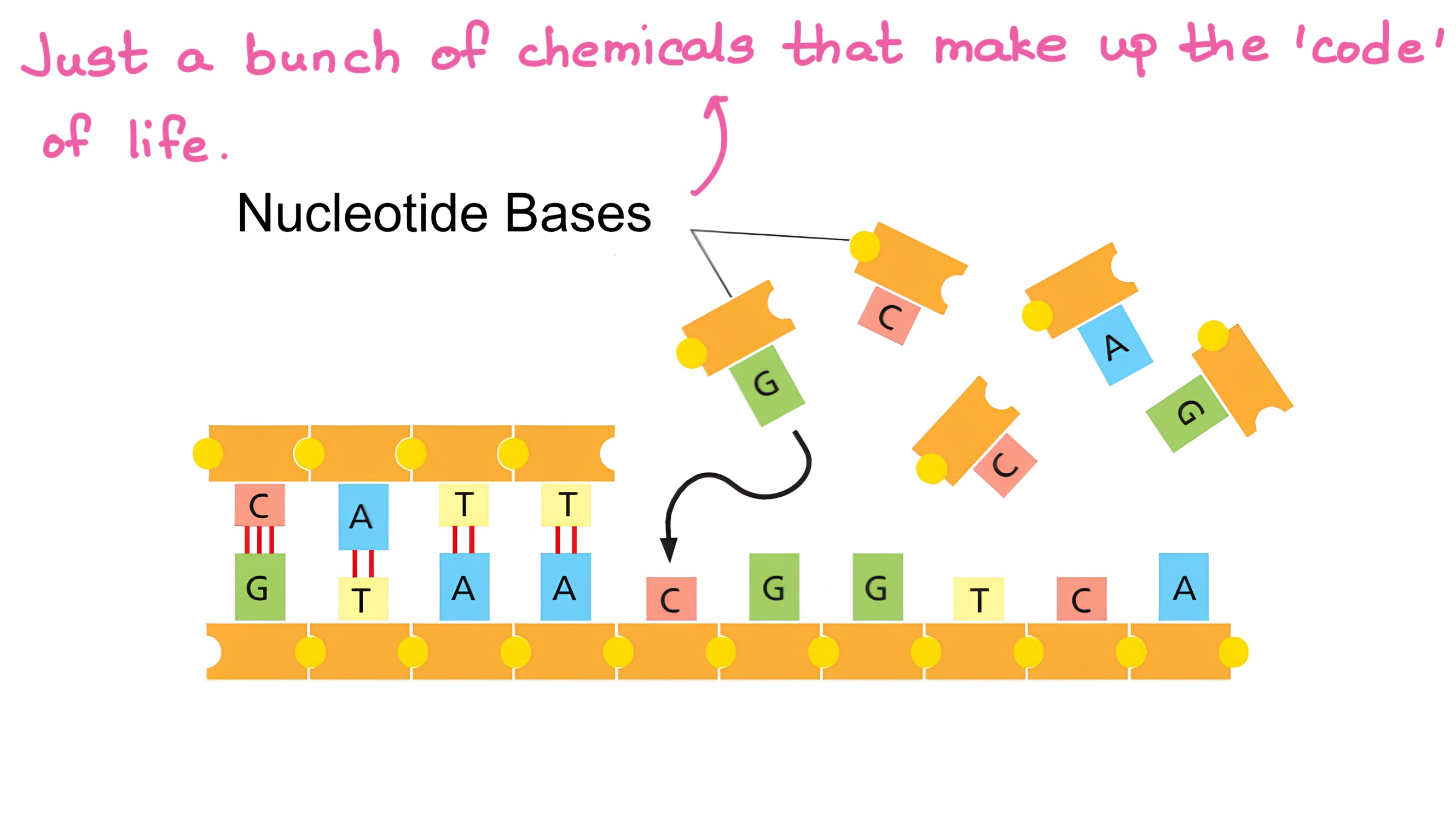
DNA replication: How complementary base pairing (A-T, G-C) ensures accurate copying of genetic information
As mentioned earlier, this molecular code itself has no intent or awareness. It is the process of natural selection that gives it the appearance of purpose. The gene’s “goal” of replication is not a conscious aim but a consequence of the natural processes that favor the survival of those sequences best suited to reproduce themselves.
Using the metaphor of Genes being selfish is equivalent to saying that your Instagram algorithm knows your interests when it is just an highly sophisticated program.
This way Nature, not humans, is the inventor of digital computers. In fact, we are the descendants of the earliest digital computers. Nature having created life made it digital hence during every replication step, no information is lost. If it were analog, losses would have occurred over time. This aspect of the genome is one of most beautiful and transcends all of life. Gregor Mendel was the first to grasp this concept. He discovered that evolution operates through digital inheritance.
Mendel's experimental findings in 1900, ushered in us to the modern age of genetics. He is known as the father of genetics.
The other thing which makes inheritance unique is that most species inherit things vertically. Most of the behaviour is hardcoded into the genome. Yet there are things which are learned from culture, the ideas which are replicated at the expense of its host, known as the term Memes coined by eminent evolutionary biologist Richard Dawkins. On one hand there is genetic inheritance which is passed down to offspring. On the other hand there is horizontal inheritance which is replication of the ideas that are built up at every generation and are horizontally transmitted.
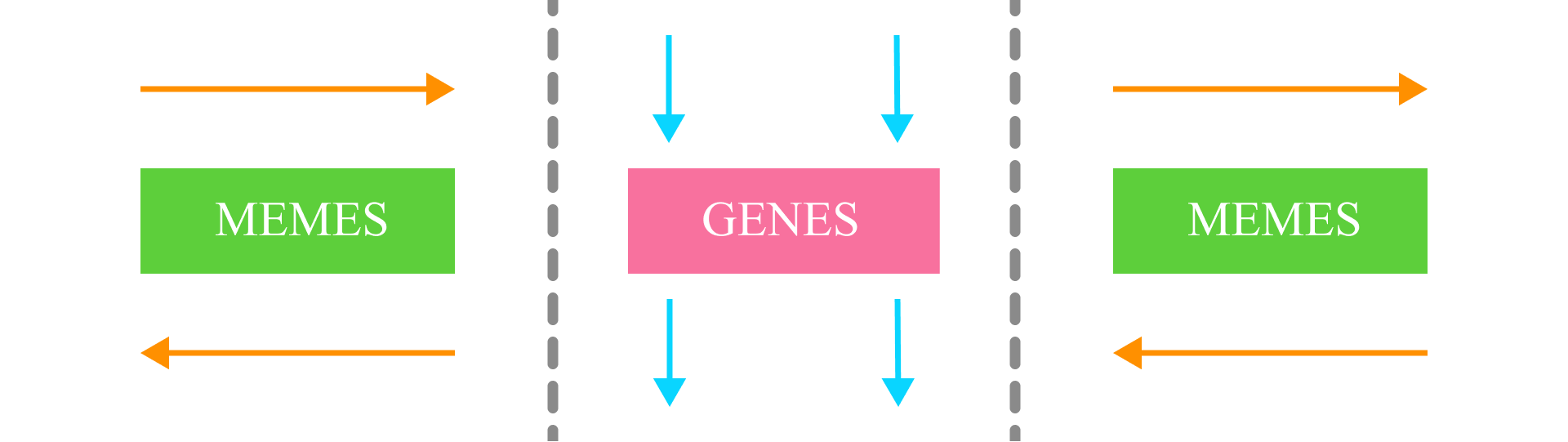
Propagation of genes & memes.
So the idea of genes dedicating the actions of individuals organisms is only half baked. It is the social culture which a reinforces behaviours or eradicates them. As said by eminent physicist and contemporary philosopher David Deutsch “Genetic Evolution was merely a prelude to Memetic Evolution”